The Soemtron ETR224 Calculator
Skip to navigation |
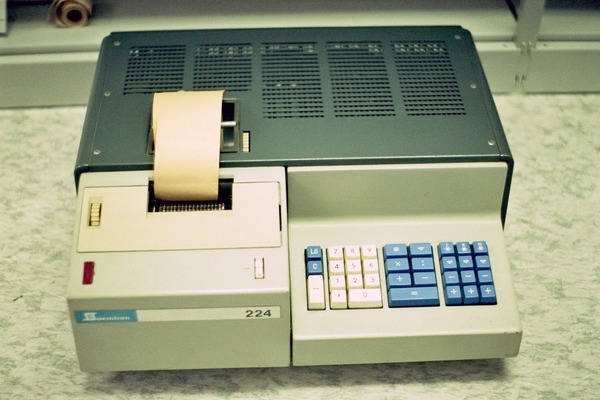 The museum's Soemtron ETR224 Click any photo for a larger image |
 Photos ↑ ©2009 Rüdiger Kurth, photo ↓ ©2009 www.soemtron.org |
 Inside the ETR224 |
Manufactured from 1968 to 1974 by V.E.B.[1] Büromaschinenwerk[2] Sömmerda, we believe only 526[3] Soemtron ETR224's were built during the six year production run from 1968–1974. With seven functions[4], the processing logic of the Soemtron ETR224 calculator, similar to that in the ETR220, is all transistorised, consisting of pairs of PNP Germanium transistors with a few resistors, capacitors and diodes coupled as Flip Flops (latches) with further sets of diodes for gating functions.
The keyboard is large and cumbersome, non-multiplexed, utilising large microswitches (thought to be V23's[6]) with external supplementary return springs for the keys themselves. The unit has three memories for intermediate calculations, each with their own set of Add, Subtract, Recall, and Recall/Clear keys, there is also a "C" key which clears the current entry and a "Lö" key which clears everything excepting the three operand stores.
This model in the Soemtron electronic calculators series has a printing capability which originally according to some was a TSD16 thermal printer. However with information gathered about the ETR224 from the Historisch–technische Museum in Sömmerda, received from Rüdiger Kurth (see below Feb 2009) after he visited the museum, it appears that the ETR224 printer is an internally mounted, semi-rotary impact type and that the ETR224 did not retain the 15 digit nixie display.
This Streifendrucker[5], is capable of printing in two colours using red for negative values and black for positive, using a standard typewriter ribbon and a very typical typewriter feed mechanism, technologies that V.E.B. Büromaschinenwerk Sömmerda were well versed in from many years making typewriters and mechanical calculators.
Decimal point selection is by a 12 position thumb–wheel switch located with the printing mechanism, but as there is no visual display on the ETR224 this switch is the only indication of the current setting. A range of decimal point selection signals are directed back to the logic circuits for use during calculations. Like the other Soemtron machines this makes the Soemtron ETR224 a "fixed point" machine rather than the usual "floating point" form found on modern calculators!
To date we have found that very little information, if any, exists about the Soemtron ETR224 and that certainly no technical information appears to have survived at all. Currently only four Soemtron ETR224's are known to exist in the wild –
- A partially working machine in the Historisch–technisches Museum in Sömmerda.
- Our machine currently undergoing restoration in the www.soemtron.org collection.
- One in the hands of a private collector in Sömmerda.
- And the fourth machine in the Museum für Historische Bürotechnik in Naunhof.

If you have any further historical information, circuits, drawings, photographs, data or manuals about the Soemtron ETR220, 221, 222, ETR224 or their manufacture, test equipment (Prüfgeräte) or you just know more about the Soemtron companies in general then please let us know, contact us.
- Photos of our Soemtron ETR224 before restoration began.
- Photos and description of the restoration progress.
August 2014 –
News about our ETR224 has been non-existent for some time now (4 years!!) as other things in life needed some attention. So to catch up -
We have essentially completed the mechanical re–building of the ETR224 printer mechanism to the extent that it works reasonably well when manually triggered, but some re–alignment is needed to the print wheels and their rest position.
Work in the last six months has concentrated on decoding the circuitry of the twelve electronics boards in the card cage, to the extent that we now have a full, but unchecked circuit for the ETR224, or see the 224 Downloads page. Currently we are working to resolve the temporary signal names (TMP–xxx) that were used in the circuit and to find solutions for the problems in the ETR224 snagging list.
Following that, the next thing we need to do is get the power supply up and running reliably, to this end the main reservoir capacitors were removed and re–formed a while back and hopefully soon we will gradually bring the supply up to working voltage under dummy load with a Variac whilst closely monitoring it, there is no way we are going to risk damaging the main electronics boards when testing the power supply.
May 2010 –
Cleaning the ETR224 we picked up last September is progressing well, all the case parts have been cleaned and re–sprayed as they were too heavily corroded to recover. The printer mechanism is now clean and has been partially reassembled, but during this process we found that one of the print wheel arms was bent and would not contact its idler gear or the print platen correctly, this bent arm has subsequently been straightened and further re–assembly continues. Having got most of the mechanism back together and run the motor it is evident that the transverse fan shaft bearings at the fan end are loosely toleranced or badly worn and have a large amount of "bearing slap" resulting in a lot of noise reverberating through the fan blades themselves. These worn bearings have been replaced and a new rubber disk fitted to the friction drive, with the result that the fan is now working well and is very much quieter.
 Print wheel layshaft assembly Click image for a larger version |  |
On disassembling the printer mechanism, it was found that a cam operated bar used to return the 18 selector racks was broken in two so the print wheels would potentially not return to their correct rest positions. The broken part was temporarily welded back together for testing purposes but the part has now been accurately measured and a mechanical drawing made, and subsequently, two new bars have been manufactured so that we can effect a full repair in the future whilst having a spare. During preliminary testing of the re–assembled unit we have also noticed a large amount of rotational miss-alignment of the print wheels at their rest position through the idler gears back to the selection racks. This appears to be related to another cam actuated bar that simultaneously releases all eighteen print wheels to make the print impression through the ribbon. As it appears there is no adjustment for this as the bar is physically pinned in position, we may need to look for other possible causational problems with the mechanism, re–pin the bar or have a new part made and re–pin that.
January 2010 –
Firstly - A happy New Year to you all.
With the New Year we have started the restoration of our ETR224, which we expect to take about a year, again with progress documented in these pages. Like the 220 pages we hope that the information gathered from this process will evolve into a full technical documentation set for the Soemtron ETR224.
November 2009 –
Our ETR224 is serial numbered 32612, which seems to roughly agree with the 1969 date codes on most of the boards, however the Core memory and Driver boards are dated 1972, so we presume they have been replaced at some point in the machines history. These two boards are 220 part coded and are the only boards that appear to be common over the whole Soemtron ETR22x range. The machine is in quite a poor condition cosmetically having been used, we think, in a meat processing factory, but it is not that far gone mechanically that it cannot be completely refurbished. The paint work in places is corroded and damaged so we will probably have the whole case stripped and re–sprayed.
Internally the condition is quite good and does not show signs of the patchy external corrosion. The machine closely resembles the Museum's ETR224 (see the bottom picture), but has an extra mechanical drive through the printer mechanism to an additional fan housing on the card cage. The right angle friction drive from the motor coupling for the fan is not functioning properly, probably due to misalignment in the fan shaft assembly or degradation of the rubber drive element. What looks to be the drive electronics for the printer solenoids is behind the printer, whereas in the Museum's ETR224 those boards are mounted on the side of the card cage, that location in our machine has the fan housing.
September 2009 - update
We drove out to Germany to pay a visit to the Historisch–technisches Museum in Sömmerda - website. For further information and photos of the visit see this page.
We met with a group of past employees from the Soemtron factory and museum staff (photos), discussed the Soemtron machines and told them how we became involved, showing them this website. A short while later during the tour of their archive, and quite out of the blue, we received a bit of a shock, an offer of a Soemtron ETR224!. Having thought that with the very small production run of ETR224's (only 526), the museum's machine was probably the only one left, how wrong we were! there were two more in a private collection! The unexpected and gracious offer of this ETR224 completes our collection of Soemtron machines - 220 - 222 - 224, and as far as we know is the only complete collection of ETR22x series machines, even of those in the museum in Sömmerda. Many, many thanks must go to the gentleman who offered us the ETR224 from his own private collection. This just confirms our thoughts on the visit of the friendly, eager, courteous and helpful reception we received from the people of Sömmerda. More news, information and photos of our newest acquisition to follow soon.
February 2009 –
One of our regular correspondents, Rüdiger Kurth has found a Soemtron ETR224 in the archive of the Historisch–technisches Museum in Sömmerda. At this time this is probably the only known example of a Soemtron ETR224 in existence!. Rüdiger has sent a couple of photos of the machine showing it to be quite different from a picture in the Büromaschinen Lexikon (click "Soemtron" in their menu), of a model 221 we mentioned last September (2008). Rüdiger has kindly allowed permission to use these photos and hopefully will also check if there is any documentation to go with the machine and if the museum will allow any internal photos - further news to come. Unbounded excitement - almost - we really did not expect to ever find an example of a Soemtron ETR224 in the wild. The keyboard colours are the same as an ETR222 machine, leading us to believe the ETR224 has the same operational logic as an ETR222, indeed our own ETR222 has logic boards with "224" part numbers, so some parts of the ETR224 were useable in the ETR222 at least.
19/2/2009 - With an update on the ETR224 printing mechanism, an email from the Historisch–technisches Museum at Sömmerda, Frau Speiser relates (translated) -
"The ETR224 followed the same method as the ETR220. A mechanical printer was fitted instead of the numerical display. The output was achieved by a 12 column printer. Negative values were shown by in red print, that means the negative values were printed in red colour. The ETR224 had an additional electronic module that was responsible for controlling the mechanical printer mechanism. The electronic basket (module) of the ETR220 was not identical to the electronic basket of the ETR224 and were not inter-changeable.
August 2008 –
Bernard Green who was Senior Engineer at Office and Electronic Machines Ltd. (OEM Ltd.)[7] in London UK has sent us his recollections of the Soemtron ETR224 printer mechanism -
"On the ETR224 we had, the printer was mounted on the top, semi-recessed into the case, and I recall it also had the Nixie tube display. I am beginning to think that we never actually sold a single ETR224 in the U.K, because either there was no market and / or the printer was too unreliable. There were photo diodes to detect the position of the print mechanism elements and that they were very unreliable and prone to ambient light".
"The print mechanism had 16 print wheels with characters and these all rotated on a common shaft. When the desired character was in the printing position, a hammer, one of sixteen, was energised to press the paper against the print wheel. A slotted disc, one slot per character rotated with the print wheels and a photo diode counted the slots into a counter, when the counter matched the digit for a column(s), the hammer(s) were driven. Another slot referenced the home position of the print wheels".
"I can also recall another print mechanism with the characters on vertical print bars. The bars were all lifted by another horizontal bar and then the bar lowered. The print bars came down with the horizontal bar until the required character was in the print position when an electro-magnet for that print bar operated to pull in a pawl hold the bar in position and prevent it falling further. Then, when the bar was fully lowered and in theory all print rods were held by their pawls, a single hammer struck to make the print. For the next row of print the bar was raised again and the individual pawls released as the bars were lifted".
So at this time we have three possible contenders for the printing mechanism on a Soemtron ETR224 –
- A rotating "drum" type mechanism with individual pin solenoids, similar to 1970's and 80's style line printers.
- A semi-mechanical lever and impact hammer system, likely to have been derived from a previous Soemtron mechanical calculator, with possibly two variants of the mechanism.
- A thermal printer.
As we now have our own Soemtron ETR224 (see the September 2009 update above), it would seem that none of the above fit the bill exactly although #2 is probably the closest. So now that we have a ETR224 in restoration, we can over time provide a thorough breakdown of the printer mechanism.
| 1 | Wikipedia entry for V.E.B. = Volks Eigener Betrieb, or Peoples Owned Company | V.E.B.[back] [top] |
| 2 | Büromaschinenwerk. | Office Machine Works.[back] [top] |
| 3 | ETR224 production of 526 during 1968-1974 | Page 389 "BWS Sömmerda", by Annegret Schüle ISBN 39-8039-311-9, ©1995 Desotron Erfurt.[back] [top] |
| 4 | Functions | Return constant, Exchange operands, Negate number, Add, Subtract, Multiply, Divide.[back] [top] |
| 5 | Streifendrucker | Strip printer.[back] [top] |
| 6 | V23 microswitch | Originally thought to be a V23 microswitch variant, the correct style is the ABB or Petercem, M & CM style switches (data sheets ABB, Petercem), but with right angle PCB pins. Data for these particular right angle PCB mount switches however, does not seem to be available even though they are from the M/CM range.[back] [top] |
| 7 | OEM Ltd. Office and Electronic Machines Ltd., 140-154, Borough High Street, London, SE1 1LH. Marketing company for mechanical Desk calculators, office equipment and supplies. "Distributors for the United Kingdom and Republic of Ireland of Adler, Triumph, and Imperial typewriters, calculators, invoicing, accounting, word processing machines, and other office equipment and machines". (Text from an advert placed by OEM Ltd, in the Glasgow Herald of the 11th June 1973 which gives their results and prospects for 1973-4.
They were also known at various times as - Office and Electronic Machines PLC., Office and Electronic Machines PLC., O.E.M. (Systems Furniture) Ltd. (#01396792), O.E.M. Orion Ltd. (#01666907), O.E.M. Orion (#1179756). They appeared to have petitioned for the winding up of several other companies as their creditors in 1979 (entry #246) and 1982 (entry #173)[back] [top] | |
Site design ©2007– soemtron.org - privacy -